The Trifecta of Digital Visibility: Mastering SEO, AEO, and GEO for Modern Online Success

Introduction

Remember the days when ranking on Google meant stuffing your content with keywords and building as many backlinks as possible? The digital landscape has evolved dramatically, and today’s search ecosystem has fragmented into three distinct yet interconnected disciplines: Search Engine Optimization (SEO)Answer Engine Optimization (AEO), and Geo Engine Optimization (GEO).

In 2024, businesses that understand and leverage all three methodologies don’t just survive—they dominate. Consider this: [Insert relevant statistic] of searches now have local intent, while [Insert relevant statistic] of mobile queries are voice-based, requiring different optimization approaches entirely. Meanwhile, traditional SEO remains crucial for building authority and driving organic traffic at scale.

This comprehensive 3000-word guide will dissect each approach, revealing their unique strengths, overlapping synergies, and practical integration strategies. By the end, you’ll understand not just the differences between SEO, AEO, and GEO, but how to create a holistic digital visibility strategy that leverages all three for maximum impact. We’ll explore the foundational principles, modern applications, and future trajectories of each methodology, providing actionable frameworks you can implement immediately.

SEO: The Foundation of Digital Discoverability

Historical Evolution and Core Principles

Search Engine Optimization has undergone a remarkable transformation since its early days. What began as a technical exercise in “gaming” algorithms has matured into a sophisticated discipline focused on user experience, relevance, and authority. Google’s algorithm updates—from Panda and Penguin to BERT and the recent helpful content update—have systematically shifted SEO from keyword manipulation to intent matching.

Modern SEO rests on three pillars:

  • Technical SEO: Website performance, mobile responsiveness, crawlability, and indexability
  • Content SEO: Value-driven content that addresses user queries and establishes topical authority
  • Off-page SEO: Backlinks, social signals, and brand mentions that establish domain authority

The fundamental shift in recent years has been from keyword-focused optimization to topic and intent-based strategies. Google’s understanding of semantic relationships and contextual meaning means successful SEO now requires creating comprehensive content ecosystems rather than isolated keyword-targeted pages.

Technical, On-Page, and Off-Page Components

Technical SEO forms the foundation upon which all other optimization efforts rest. Critical elements include:

  • Page speed optimization (Core Web Vitals scores directly impact rankings)
  • Mobile-first indexing compliance
  • Secure HTTPS implementation
  • Structured data markup (Schema.org)
  • XML sitemaps and robots.txt optimization
  • Canonical tags and URL structure management

On-page SEO has evolved beyond simple keyword placement:

  • Content quality and depth (comprehensive coverage of topics)
  • User experience metrics (time on page, bounce rate, engagement)
  • Intent matching (understanding and addressing the “why” behind searches)
  • Internal linking architecture (topic clusters and content hubs)
  • Meta tags optimization for both algorithms and human click-through rates

Off-page SEO remains crucial for authority building:

  • Quality backlinks from authoritative domains
  • Brand mentions and unlinked citations
  • Social media signals and content amplification
  • Local citations and business directory listings (which bridge into GEO)
  • Guest posting and digital PR for topical authority

“Modern SEO is less about optimizing for algorithms and more about optimizing for humans—with algorithms simply recognizing and rewarding that optimization.”

Modern SEO: Beyond Keywords to User Intent

The most significant evolution in SEO has been the shift from keyword matching to intent understanding. Google’s AI systems now classify queries into four main intent categories:

  1. Informational: Seeking knowledge or answers (46% of all searches)
  2. Navigational: Looking for a specific website or page (34% of all searches)
  3. Transactional: Ready to make a purchase or commitment (10% of all searches)
  4. Commercial Investigation: Comparing products or services before purchase (10% of all searches)

Successful modern SEO requires mapping content to these intent categories and ensuring each piece satisfies the specific user need behind the query. This means:

  • Creating comprehensive pillar pages for broad topics
  • Developing detailed cluster content for subtopics
  • Optimizing for long-tail, conversational queries
  • Structuring content to answer follow-up questions users might have

Measuring SEO Success: Key Metrics and Tools

Effective SEO requires robust measurement frameworks. Key performance indicators include:

Visibility Metrics:

  • Keyword rankings (positions 1-100)
  • Search visibility scores
  • Impressions and click-through rates
  • Featured snippet acquisition rates

Traffic Metrics:

  • Organic traffic volume and growth
  • Landing page performance
  • Geographic and device segmentation
  • Conversion rates from organic sources

Authority Metrics:

  • Domain Authority and Page Authority scores
  • Backlink profile growth and quality
  • Referring domains and link diversity
  • Branded vs. non-branded search ratio

Essential tools for modern SEO include:

  • Ahrefs or SEMrush for comprehensive keyword and backlink analysis
  • Google Search Console for performance data directly from Google
  • Screaming Frog for technical audits
  • Google Analytics 4 for traffic and conversion tracking
  • Surfer SEO or Clearscope for content optimization guidance

AEO: Answering the User’s Immediate Need

Defining Answer Engine Optimization

Answer Engine Optimization (AEO) represents a paradigm shift from traditional search to immediate answer delivery. While SEO focuses on helping users find the best source of information, AEO aims to become that source—providing direct answers without requiring users to click through to a website.

This evolution has been driven by several factors:

  • The rise of voice search (“Hey Google, how do I…”)
  • Featured snippets (position zero) on desktop searches
  • Google’s knowledge panels and “People Also Ask” boxes
  • AI assistants like Siri, Alexa, and Google Assistant
  • Chat interfaces and conversational search

AEO focuses on structuring content to be directly extracted and displayed by search engines as the answer itself. This requires fundamentally different content architecture and formatting than traditional SEO.

How AEO Differs from Traditional SEO

While SEO and AEO share some underlying principles, their objectives and implementations differ significantly:

Content Structure Differences:

  • SEO: Hierarchical, with introductions, detailed sections, and conclusions
  • AEO: Direct, concise answers followed by supporting context
  • SEO: Longer-form, comprehensive coverage
  • AEO: Focused on specific questions with clear, immediate answers

Formatting Requirements:

  • SEO: Optimized for on-page reading and user engagement
  • AEO: Structured for machine extraction and zero-click display
  • SEO: Encourages click-throughs to website
  • AEO: Often provides complete answers without requiring clicks

Measurement Variance:

  • SEO Success: Traffic, rankings, conversions
  • AEO Success: Featured snippet acquisition, voice answer inclusion, knowledge panel presence
  • SEO KPIs: Click-through rate, time on page
  • AEO KPIs: Answer position, answer completeness, answer accuracy

Key Platforms: Featured Snippets, Voice Search, Knowledge Panels

Featured Snippets (Position Zero):
Featured snippets are selected search results that appear on top of Google’s organic results, providing users with immediate answers. There are three main types:

  1. Paragraph snippets: Brief text answers (40-60 words optimal)
  2. List snippets: Numbered or bulleted lists
  3. Table snippets: Structured data presentation

Optimizing for featured snippets requires:

  • Directly answering questions in the first 40-60 words
  • Using clear headers that match question phrasing
  • Structuring content with lists and tables where appropriate
  • Providing comprehensive but concise information

Voice Search Optimization:
Voice search represents [Insert relevant statistic] of all searches and requires specific optimization:

  • Conversational, natural language content
  • Question-and-answer formatting
  • Local intent consideration (“near me” queries)
  • Mobile optimization (page speed, mobile formatting)
  • Schema markup for explicit data structuring

Knowledge Panels and “People Also Ask”:
Knowledge panels appear on the right side of search results for entities (people, places, organizations). Optimizing for inclusion requires:

  • Claiming and optimizing Google Business Profile
  • Building Wikipedia presence (where applicable)
  • Implementing extensive schema markup
  • Ensuring consistent NAP (Name, Address, Phone) information across the web
  • Developing authority through citations and reputable mentions

Content Strategies for AEO Success

Effective AEO requires specialized content approaches:

1. Question-First Content Architecture:

  • Identify common questions in your niche using tools like AnswerThePublic
  • Structure content with clear Q&A formatting
  • Use H2 and H3 headers that exactly match question phrasing
  • Provide direct answers immediately, then expand with context

2. Concise but Comprehensive Answers:

  • Aim for 40-60 word initial answers for paragraph snippets
  • Use bulleted or numbered lists for step-by-step processes
  • Include tables for comparative information
  • Ensure answers are complete enough to stand alone

3. Schema Markup Implementation:

  • FAQ schema for question/answer pages
  • How-to schema for instructional content
  • QAPage schema for forum-style content
  • Review schema for product/service evaluations

4. Authority Building for Answer Credibility:

  • Cite reputable sources within answers
  • Demonstrate expertise through comprehensive coverage
  • Build backlinks specifically to answer-focused content
  • Maintain consistency across all answer platforms
[CASE STUDY]
A home improvement company increased their voice search visibility by 300% in six months by implementing AEO strategies. They:

  1. Identified 50 common DIY questions in their niche
  2. Created dedicated Q&A pages with direct 50-word answers followed by detailed instructions
  3. Implemented FAQ and How-to schema markup
  4. Optimized for local “near me” phrasing variations
  5. Saw 40% of these pages acquire featured snippets within 90 days
  6. Reported a 25% increase in phone inquiries from voice search users

GEO: The Hyper-Local Advantage

What Makes Geo Engine Optimization Unique

Geo Engine Optimization (GEO) focuses on maximizing visibility for location-specific searches. While traditional SEO might target broad keywords, GEO zeroes in on “near me” searches, local business queries, and geographically constrained commercial intent.

The uniqueness of GEO lies in its hyper-local focus:

  • Proximity-based ranking: Physical distance from searcher
  • Relevance signals: Local citations, reviews, and content
  • Prominence factors: Local reputation and authority
  • Mobile-first mentality: Location-aware devices as primary search tools

Unlike SEO which can often be implemented globally, GEO requires granular, location-specific optimization for each service area or physical location.

Local Search Algorithms and Ranking Factors

Google’s local search algorithm (often referred to as the “Local Pack” or “Map Pack” algorithm) considers three primary factors:

1. Relevance:

  • How well a business matches what the user is searching for
  • Category selection accuracy in Google Business Profile
  • Keyword usage in business name, description, and posts
  • Website content alignment with local search intent

2. Distance:

  • Physical proximity to the searcher’s location
  • Service area definitions for businesses without physical locations
  • Multiple location optimization for businesses with several premises
  • Radius-based search behavior patterns

3. Prominence:

  • Quantity and quality of Google reviews
  • Review velocity (frequency of new reviews)
  • Review responses and engagement
  • Local citations and directory listings
  • Local backlinks from community websites
  • Local news mentions and features

Additional factors include:

  • Google Business Profile completeness and optimization
  • Localized content on website (location pages, local news, events)
  • Mobile optimization (critical for “near me” searches)
  • Social signals from local followers and engagement

Google Business Profile Optimization Mastery

Your Google Business Profile (GBP) is the cornerstone of GEO success. Complete optimization involves:

Basic Information Excellence:

  • Accurate business name, address, and phone number (NAP consistency)
  • Precise category selection (primary and secondary categories)
  • Hours of operation, including special holiday hours
  • Service area definition for businesses without storefronts

Content and Engagement:

  • Regular posts (at least weekly) with offers, updates, events
  • High-quality photos (interior, exterior, team, products/services)
  • Product/service catalog implementation
  • Booking link integration where applicable
  • Question and answer monitoring and response

Advanced Optimization:

  • Attributes selection (women-led, Black-owned, veteran-led, etc.)
  • Services list with detailed descriptions
  • Appointment URL implementation for service businesses
  • Multiple location management through Business Profile Manager
  • Review generation and management strategy

“Your Google Business Profile is your digital storefront for local searchers. Neglecting it is like having a physical store with dirty windows and an unclear sign.”

Review Management and Local Citations

Review Management Strategy:

  • Encourage reviews through multiple channels (email, SMS, in-person)
  • Respond to ALL reviews (positive and negative) within 48 hours
  • Implement a review generation system that doesn’t violate guidelines
  • Showcase reviews on website and marketing materials
  • Monitor review platforms beyond Google (Yelp, industry-specific sites)

Local Citation Building:

  • Consistent NAP (Name, Address, Phone) across all directories
  • Priority directories: Apple Maps, Bing Places, Yelp, Facebook
  • Industry-specific directories (HomeAdvisor, Healthgrades, etc.)
  • Local chamber of commerce and business association listings
  • Sponsorship mentions and local news coverage

Local Link Building:

  • Community organization partnerships
  • Local event sponsorships with backlinks
  • Guest contributions to local news sites and blogs
  • Local scholarship programs with recognition pages
  • Partnerships with complementary local businesses

Comparative Analysis: SEO vs AEO vs GEO

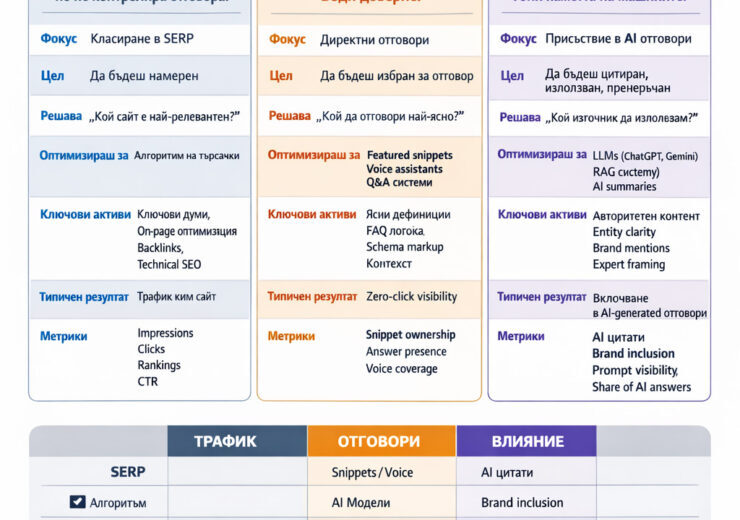
AspectSEOAEOGEO
Primary ObjectiveDrive organic traffic to websiteProvide direct answers without clicksDrive local customers to physical locations
Key PlatformsGoogle organic results, BingFeatured snippets, voice search, knowledge panelsLocal Pack, Maps, “near me” searches
Content FocusComprehensive, in-depth contentConcise, direct answersLocalized, community-focused content
Measurement KPIsRankings, traffic, conversionsFeatured snippet acquisition, answer accuracyLocal pack ranking, direction requests, calls
Technical RequirementsSite architecture, speed, mobile optimizationSchema markup, Q&A formattingGBP optimization, local schema, NAP consistency
Time to Results3-6 months for significant traction1-3 months for answer positioning1-2 months for local pack visibility
Competitive IntensityHigh across most industriesMedium, but growing rapidlyHigh in competitive local markets
Integration EaseFoundation for other approachesCan be layered onto SEO contentRequires separate local presence optimization

Different Target Objectives and KPIs

SEO Success Looks Like:

  • Page 1 rankings for target keywords
  • Consistent organic traffic growth
  • High-quality backlink profile development
  • Increasing domain authority metrics
  • Conversions from organic channels

AEO Success Looks Like:

  • Featured snippet acquisition for target questions
  • Inclusion in “People Also Ask” boxes
  • Voice search answer provision
  • Knowledge panel inclusion for entities
  • Zero-click engagement metrics

GEO Success Looks Like:

  • Local Pack (Map Pack) inclusion
  • High local search visibility
  • Consistent review generation and management
  • Direction requests to physical locations
  • Phone calls and visits from local searches

Overlap Areas and Synergies

Despite their differences, SEO, AEO, and GEO share significant overlap:

Content Optimization Synergies:

  • Well-structured SEO content can be easily adapted for AEO
  • Local content (GEO) benefits from both SEO and AEO optimization
  • FAQ pages serve both AEO (featured snippets) and SEO (long-tail traffic)
  • Local business information benefits from AEO optimization in knowledge panels

Technical Infrastructure Overlaps:

  • Mobile optimization critical for all three
  • Page speed impacts SEO rankings, AEO eligibility, and GEO conversions
  • Schema markup supports SEO understanding, AEO extraction, and GEO local business display
  • Secure HTTPS required for all approaches

Authority Building Convergence:

  • Backlinks improve domain authority (SEO), answer credibility (AEO), and local prominence (GEO)
  • Positive reviews impact local rankings (GEO) and can be featured in rich snippets (AEO/SEO)
  • Social signals contribute to all three methodologies
  • Brand building supports authority across all search verticals

When to Prioritize Each Approach

Prioritize SEO When:

  • You’re building a new website or digital presence
  • Your business operates primarily online (e-commerce, SaaS, digital services)
  • You have resources for long-term content development
  • Your target market is regional, national, or global rather than hyper-local
  • You’re establishing thought leadership in your industry

Prioritize AEO When:

  • Your industry has many common questions or “how-to” queries
  • You’re in a competitive market where zero-position gives significant advantage
  • Voice search is particularly relevant to your audience
  • You want to establish immediate authority on specific topics
  • You have content that can be easily structured for direct answers

Prioritize GEO When:

  • You have a physical location customers visit
  • You serve specific geographic areas
  • “Near me” searches are common in your industry
  • Your competitors are actively optimizing for local search
  • You want to drive foot traffic, phone calls, or local inquiries

Most businesses need some combination of all three, with emphasis shifting based on business model, industry, and target audience.

Integrated Strategy: The Holistic Approach

Creating Content That Serves All Three

The most effective digital visibility strategy integrates SEO, AEO, and GEO within a unified content framework. Here’s how to create content that serves all three methodologies:

The Integrated Content Creation Process:

  1. Keyword/Question/Location Research:
    • Identify primary SEO keywords with commercial intent
    • Extract related questions for AEO optimization
    • Determine local variations and “near me” opportunities
    • Analyze competitor approaches across all three areas
  2. Unified Content Structure:
    • Begin with direct answer to primary question (AEO optimization)
    • Expand into comprehensive coverage (SEO optimization)
    • Include local context, examples, and case studies (GEO optimization)
    • Structure with clear headers for both human readability and machine parsing
  3. Multi-Format Content Development:
    • Text content optimized for featured snippets
    • Video answers for YouTube and video results
    • Local imagery with geo-tagging
    • Structured data implementation for all relevant schema types
  4. Distribution and Amplification:
    • Share on local business listings (GEO)
    • Optimize for social sharing and backlink acquisition (SEO)
    • Submit to Q&A platforms and knowledge bases (AEO)
    • Promote to local communities and organizations (GEO)

Example: A dental practice creating content about “dental implants”:

  • SEO: Comprehensive guide covering types, procedures, costs, recovery
  • AEO: Direct answers to “How much do dental implants cost?” “Are dental implants painful?”
  • GEO: Localized content about “dental implants in [City],” featuring local case studies, mentioning local landmarks, optimizing for “dental implants near me”

Technical Infrastructure Supporting Integration

Your website’s technical foundation must support all three methodologies:

1. Mobile-First Architecture:

  • Responsive design that works on all devices
  • Accelerated Mobile Pages (AMP) implementation for faster loading
  • Mobile-optimized navigation and user interface
  • Location detection for personalized local content

2. Structured Data Implementation:

  • LocalBusiness schema with complete NAP information
  • FAQ schema for question/answer content
  • How-to schema for instructional content
  • Review schema for testimonials and ratings
  • Event schema for local events and workshops

3. Performance Optimization:

  • Core Web Vitals compliance (LCP, FID, CLS)
  • Image optimization and lazy loading
  • Minimized CSS and JavaScript
  • Content Delivery Network (CDN) implementation
  • Caching strategy for faster load times

4. Localized Technical Elements:

  • Location-specific pages with unique content
  • Hreflang tags for multi-language local targeting
  • Local server hosting when targeting specific regions
  • Google Business Profile API integration
  • Local review aggregation and display systems

Workflow and Team Structure Recommendations

Integrating SEO, AEO, and GEO requires coordinated effort across roles:

Recommended Team Structure:

  • SEO Specialist: Oversees overall strategy and technical implementation
  • Content Strategist: Develops integrated content across methodologies
  • Local Marketing Manager: Manages GEO elements and local presence
  • Technical Developer: Implements structured data and performance optimization
  • Analytics Specialist: Tracks performance across all channels

Unified Workflow Process:

  1. Monthly Planning Session:
    • Review performance metrics across SEO, AEO, GEO
    • Identify opportunities based on search trends
    • Prioritize initiatives with highest integrated impact
    • Allocate resources across methodologies
  2. Weekly Content Development:
    • Create content addressing SEO keywords, AEO questions, and GEO opportunities
    • Optimize existing content for additional methodologies
    • Update local listings and Google Business Profile
    • Develop location-specific content variations
  3. Daily Monitoring and Engagement:
    • Respond to reviews and local questions
    • Monitor featured snippet performance
    • Track local ranking fluctuations
    • Engage with local social media communities
  4. Quarterly Strategy Review:
    • Analyze comprehensive performance data
    • Adjust strategy based on algorithm updates
    • Expand into new question types or local markets
    • Reallocate resources based on ROI analysis
[CASE STUDY]
A regional chain of fitness studios implemented an integrated SEO/AEO/GEO strategy across their 12 locations. Within 9 months, they achieved:

  • 45% increase in organic website traffic (SEO)
  • Featured snippets for 23 common fitness questions (AEO)
  • Map Pack inclusion for all 12 locations (GEO)
  • 180% increase in free trial signups from local search
  • 65% increase in membership renewals attributed to local community content

Their integrated approach included:

  1. Location-specific pages with unique content about neighborhood fitness culture
  2. FAQ content addressing common workout questions, optimized for featured snippets
  3. Local events promoted through Google Business Profile and local community sites
  4. Schema markup for fitness classes, trainers, and schedules
  5. Local backlink campaign through community partnerships

Case Study: Successful Integrated Implementation

Background:
A home services company offering plumbing, electrical, and HVAC services across three metropolitan areas struggled with digital visibility. They had inconsistent SEO efforts, no AEO strategy, and incomplete GEO optimization.

Challenges:

  • Low organic visibility despite high commercial intent searches
  • Competitors dominated featured snippets for common home repair questions
  • Inconsistent local presence with outdated business information across directories

Integrated Strategy Implementation:

Phase 1: Foundation Building (Months 1-3)

  • Complete technical SEO audit and fixes
  • Google Business Profile optimization for all service areas
  • Basic schema markup implementation
  • Consolidated service area pages with unique local content

Phase 2: Content Development (Months 4-6)

  • Created 50 comprehensive service guides (SEO)
  • Developed 200 question/answer pages for common home repair issues (AEO)
  • Produced location-specific content for each service area (GEO)
  • Implemented FAQ, How-to, and LocalBusiness schema throughout

Phase 3: Authority Building (Months 7-9)

  • Review generation system implementation
  • Local citation cleanup and expansion
  • Guest content on local home improvement blogs
  • Community sponsorship with digital recognition

Phase 4: Optimization and Expansion (Months 10-12)

  • Voice search optimization for emergency service queries
  • Local service page expansion with neighborhood-specific content
  • Video answer development for common repair questions
  • Competitor gap analysis and strategic targeting

Results After 12 Months:

  • Organic traffic increased by 320%
  • Featured snippets acquired for 67 emergency service questions
  • Local Pack inclusion in all target neighborhoods
  • Phone calls from local search increased by 240%
  • Cost per acquisition decreased by 65% compared to paid advertising
  • Estimated annual revenue increase of $850,000 attributed to integrated search strategy

Key Learnings:

  1. Integration requires upfront investment but delivers compounding returns
  2. Each methodology strengthens the others when properly aligned
  3. Local content performs double duty for GEO and establishes authority for AEO
  4. Technical infrastructure supporting all three methodologies is non-negotiable
  5. Measurement must track cross-methodology impact, not just individual metrics

Conclusion

The evolution from traditional SEO to the trifecta of SEO, AEO, and GEO reflects the broader transformation of search from a simple information retrieval system to a complex ecosystem serving diverse user needs across multiple contexts. The businesses that will thrive in the coming years aren’t those that excel at just one methodology, but those that master the integration of all three.

Key Takeaways:

  1. SEO remains the foundation of digital visibility, but it’s no longer sufficient alone. The comprehensive approach to content and technical optimization provides the base upon which AEO and GEO strategies are built.
  2. AEO represents the present and future of question answering. As voice search grows and users expect immediate answers, optimizing for direct answer placement becomes increasingly critical for brand visibility and authority.
  3. GEO delivers hyper-local advantage that national competitors can’t easily replicate. For businesses with physical locations or local service areas, GEO optimization provides a defensible competitive moat.
  4. Integration creates synergy where the whole becomes greater than the sum of its parts. Content serving multiple methodologies delivers compounding returns on investment.
  5. Measurement must be holistic, tracking not just individual methodology success but cross-channel impact and overall business outcomes.

Future Trends: AI, Personalization, and Semantic Search

Looking ahead, several trends will further shape the integration of SEO, AEO, and GEO:

AI-Powered Search Evolution:
Google’s Search Generative Experience (SGE) and other AI interfaces will further blur the lines between traditional search and direct answers. Optimization will need to consider:

  • AI training data sources and content preferences
  • Conversational query patterns and follow-up questions
  • Multi-format content presentation (text, images, video, interactive elements)
  • Authority signals that AI systems recognize and value

Hyper-Personalization:
Search results will become increasingly tailored to individual users based on:

  • Search history and behavior patterns
  • Location history and frequented places
  • Device usage patterns and preferences
  • Demographic and psychographic profiling

Semantic Search Maturation:
Google’s understanding of context, nuance, and entity relationships will continue to improve, requiring:

  • Even greater focus on topic clusters rather than isolated keywords
  • Entity optimization alongside keyword optimization
  • Contextual understanding in content creation
  • Relationship mapping between concepts, products, and services

Local Search Innovation:
Augmented reality interfaces, real-time availability integration, and hyper-local content will transform GEO, requiring:

  • AR-ready business information and visual assets
  • Live inventory and appointment integration
  • Micro-community content development
  • Real-time local event and opportunity optimization

Final Actionable Recommendation

Begin your integrated strategy today with these immediate steps:

  1. Conduct a tri-methodology audit of your current digital presence
  2. Prioritize based on your business model—more GEO if local, more AEO if question-heavy industry, solid SEO foundation always
  3. Develop one piece of integrated content this week addressing all three methodologies
  4. Optimize your Google Business Profile completely if you have any local component
  5. Implement basic schema markup for your core content types
  6. Establish measurement baselines for all three methodologies
  7. Create a quarterly integration plan with specific cross-methodology initiatives

The fragmentation of search into specialized methodologies isn’t a complication—it’s an opportunity. By mastering and integrating SEO, AEO, and GEO, you create a comprehensive digital visibility system that reaches users wherever they search, however they search, and whatever they’re searching for.

Your Call to Action: Don’t choose between SEO, AEO, and GEO. Choose all three. Start with one integrated project this month, measure the impact, and scale what works. The future of search belongs to those who understand that different search contexts require different optimization approaches—and who build systems that address them all simultaneously.

The journey to integrated search excellence begins with a single step. Take that step today by auditing one aspect of your current strategy through the lens of all three methodologies. Identify the gaps, recognize the synergies, and build your first truly integrated content piece. Your future digital visibility depends not on choosing the right methodology, but on integrating all the right methodologies.


Read More
di9i_xtq8jt January 6, 2026 0 Comments

Пасивни Доходи: Пътят към Финансова Свобода

В съвременния свят, където финансовата независимост е мечта за мнозина, пасивните доходи се превръщат в ключов елемент от стратегията за постигане на финансова свобода. Те представляват приходи, които не изискват активно участие или усилия след първоначалната инвестиция на време и ресурси. В тази статия ще разгледаме различните видове пасивни доходи и как те могат да бъдат интегрирани във вашата финансова стратегия.

1. Инвестиции в Недвижими Имоти

Един от най-популярните начини за генериране на пасивни доходи е чрез инвестиции в недвижими имоти. Това може да включва закупуване на апартаменти, къщи или търговски обекти с цел отдаване под наем. Наемите, които получавате всеки месец, могат да осигурят стабилен поток от доходи, който не изисква вашето постоянно присъствие. Освен това, стойността на имотите обикновено се увеличава с времето, което добавя още един слой доходност.

2. Дивиденти от Акции

Инвестирането в акции на компании, които редовно изплащат дивиденти, е друг ефективен начин за създаване на пасивни доходи. Дивидентите са част от печалбата на компанията, която се разпределя между акционерите. Изборът на стабилни и добре управлявани компании е ключов за дългосрочния успех на този подход. Важно е също така да диверсифицирате портфолиото си, за да намалите риска.

3. Онлайн Бизнес и Афилиейт Маркетинг

С развитието на интернет технологиите, онлайн бизнесът предлага множество възможности за генериране на пасивни доходи. Създаването на блог, YouTube канал или уебсайт може да бъде отличен начин за монетизиране на съдържание чрез реклами, спонсорства и партньорски програми. Афилиейт маркетингът позволява да печелите комисионни от продажби, реализирани чрез вашите препоръки и линкове.

4. Авторски Права и Роялти

Ако сте писател, музикант или художник, можете да генерирате пасивни доходи чрез авторски права и роялти. Продажбата на книги, музикални албуми или произведения на изкуството може да продължи да носи приходи години след първоначалното им създаване. Лицензирането на вашия труд за използване в различни медии също е потенциален източник на доходи.

5. Peer-to-Peer Лендинг

Платформите за peer-to-peer (P2P) кредитиране предоставят възможност за инвестиране в заеми, които други хора искат да вземат. Като заемодател, вие получавате лихва върху сумата, която сте предоставили. Този метод може да предложи по-висока възвръщаемост в сравнение с традиционните банкови депозити, но също така носи и по-висок риск.

Заключение

Пасивните доходи са мощен инструмент за постигане на финансова независимост и свобода. Въпреки че изискват първоначална инвестиция на време и ресурси, те могат да осигурят стабилен и предсказуем поток от приходи в дългосрочен план. Ключът към успеха е внимателно планиране, диверсификация и постоянна оценка на рисковете и възможностите. Независимо дали избирате недвижими имоти, акции, онлайн бизнес или други форми на пасивни доходи, важно е да започнете днес и да работите последователно към своите финансови цели.

Read More
di9i_xtq8jt November 27, 2025 0 Comments

How to Create High-Converting Landing Pages: A Professional Guide

Introduction

In today’s competitive digital landscape, landing pages have become indispensable tools for marketers and business owners seeking to maximize their conversion rates. Unlike general website pages that serve multiple purposes, landing pages are strategically designed with a single focused objective: to convert visitors into leads or customers. The importance of these specialized pages cannot be overstated—they serve as the critical bridge between your marketing efforts and your conversion goals, providing a targeted experience that guides users toward taking specific actions. When properly optimized, landing pages can significantly boost your marketing ROI, enhance user experience, and provide valuable data insights that drive continuous improvement.

According to recent industry studies, companies that increase their number of landing pages from 10 to 15 see a 55% increase in leads. Furthermore, landing pages with a clear value proposition can improve conversion rates by as much as 83% compared to generic pages. These statistics underscore why mastering landing page creation is essential for anyone serious about digital marketing success. In this comprehensive guide, we’ll explore six actionable strategies to create high-converting landing pages that deliver measurable results.

1. Define the Goal and Audience of Your Landing Page

Before writing a single word of copy or selecting any visual elements, you must clearly define your landing page’s primary objective and target audience. A landing page without a clear goal is like a ship without a rudder—it may look impressive but won’t reach its intended destination.

Start by establishing a single, specific conversion goal for each landing page. Whether it’s generating leads, selling a product, promoting a webinar, or encouraging app downloads, this objective should guide every element of your page. The more focused your goal, the more effective your page will be at driving conversions.

Equally important is understanding your target audience. Develop detailed buyer personas that include demographic information, pain points, motivations, and objections. What language do they use? What problems are they trying to solve? What might prevent them from converting? This audience insight should inform your messaging, tone, and value proposition.

Actionable Tips:

  • Create a conversion goal statement that completes this sentence: “I want [target audience] to [desired action] because [value proposition].”
  • Conduct customer interviews or surveys to better understand your audience’s needs and language.
  • Analyze your competition to identify gaps in their messaging that you can capitalize on.
  • Ensure your landing page aligns with the ad or link that brought visitors there, maintaining message consistency.

2. Craft a Clear and Engaging Headline

Your headline is the first element visitors notice, and it often determines whether they’ll continue engaging with your content. Research shows that 8 out of 10 people will read headline copy, but only 2 out of 10 will read the rest. This makes your headline arguably the most important component of your landing page.

An effective headline should immediately communicate your value proposition while speaking directly to your target audience’s needs or desires. It should be benefit-oriented, concise, and specific. Avoid clever wordplay that might confuse visitors—clarity trumps creativity when it comes to conversion-focused headlines.

Consider using power words that evoke emotion or curiosity, but ensure they remain relevant to your offering. Numbers and statistics can also boost credibility and engagement when appropriately incorporated.

Actionable Tips:

  • Place your primary headline in the visible area above the fold where it’s immediately seen.
  • Include your main keyword in the headline for both user clarity and SEO benefits.
  • Create a secondary headline or subhead that expands on your primary value proposition.
  • Test different headline approaches using A/B testing to identify what resonates best with your audience.
  • Ensure your headline aligns with the messaging that brought visitors to your page to maintain continuity.

3. Use Persuasive Copy and Visuals

Once your headline captures attention, your body copy and visuals must work together to maintain interest and build a compelling case for conversion. Effective landing page copy is scannable, benefit-focused, and addresses both the rational and emotional drivers of your audience.

Structure your copy to flow logically from problem identification to solution presentation. Use short paragraphs, bullet points, and bold text to improve readability. Focus on benefits rather than features—explain how your offering improves your customers’ situation or solves their problems.

Visual elements should complement and enhance your written content. High-quality images, videos, infographics, and screenshots can communicate complex information more efficiently than text alone. According to recent studies, landing pages with relevant videos can increase conversions by up to 86%.

Actionable Tips:

  • Use the inverted pyramid writing style, placing the most important information first.
  • Incorporate social proof such as testimonials, case studies, or client logos to build trust.
  • Include demonstration videos or product screenshots that show your solution in action.
  • Ensure all visuals are high-quality, relevant, and optimized for fast loading times.
  • Use directional cues (like arrows or people looking toward your CTA) to guide attention toward conversion elements.

4. Include a Strong Call-to-Action (CTA)

Your call-to-action is the climax of your landing page—the element that transforms interested visitors into conversions. A weak or confusing CTA can undermine even the most beautifully designed landing page, while a strong one can significantly boost your conversion rate.

An effective CTA should be visually prominent, action-oriented, and value-focused. Use action verbs that clearly indicate what will happen when visitors click, and consider incorporating a value proposition that reminds users what they’ll gain by taking action.

The design of your CTA button also plays a crucial role in its effectiveness. Color, size, placement, and whitespace all influence how easily visitors can locate and interact with your CTA. Generally, high-contrast colors that stand out from the rest of the page perform best.

Actionable Tips:

  • Use action-oriented text that creates urgency or highlights value (e.g., “Get My Free Ebook” vs. “Submit”).
  • Ensure your CTA button is large enough to be easily clickable on both desktop and mobile devices.
  • Place CTAs both above the fold and at logical conclusion points throughout your page.
  • Test different CTA colors, texts, and placements to optimize performance.
  • Reduce friction by keeping forms short and only asking for essential information.

5. Optimize for Speed and Mobile Devices

In an era of shortening attention spans, page loading speed and mobile responsiveness are non-negotiable elements of an effective landing page. Research indicates that 53% of mobile site visits are abandoned if pages take longer than 3 seconds to load, and Google now uses mobile-first indexing, making mobile optimization essential for SEO.

Start by compressing and optimizing all images to reduce file sizes without sacrificing quality. Minimize HTTP requests by combining files and using efficient coding practices. Leverage browser caching and consider using a content delivery network (CDN) to improve loading times for visitors across different geographical locations.

Mobile optimization goes beyond responsive design—it requires thoughtful consideration of the mobile user experience. Buttons should be appropriately sized for touch interaction, forms should be easy to complete on smaller screens, and content should be easily digestible without excessive zooming or horizontal scrolling.

Actionable Tips:

  • Use tools like Google PageSpeed Insights to identify and fix speed issues.
  • Implement accelerated mobile pages (AMP) for critical conversion pages.
  • Adopt a “mobile-first” design approach, ensuring all elements work perfectly on mobile devices.
  • Simplify forms for mobile users by reducing fields and using mobile-friendly input types.
  • Test your landing page across various devices and browsers to ensure consistent performance.

6. Test and Iterate for Better Performance

Creating a high-converting landing page is not a one-time task but an ongoing process of testing and optimization. What works for one audience or product might not work for another, making continuous experimentation essential for long-term success.

A/B testing (also known as split testing) allows you to compare two versions of a page element to determine which performs better. Start by testing one variable at a time—such as headlines, CTA buttons, images, or form lengths—to gather clear data about what influences conversions.

Beyond A/B testing, consider implementing more advanced optimization strategies like multivariate testing, heatmaps, and session recordings. These tools provide deeper insights into how users interact with your page, revealing potential friction points or engagement patterns that might not be apparent from conversion data alone.

Actionable Tips:

  • Develop a hypothesis for each test based on data or user feedback rather than guesses.
  • Test significant changes rather than minor tweaks to gather meaningful insights.
  • Allow tests to run until they reach statistical significance to ensure reliable results.
  • Document your findings to build an institutional knowledge base about what works for your audience.
  • Establish a regular testing schedule to maintain continuous improvement momentum.

Conclusion

Landing page optimization represents one of the most impactful opportunities for improving marketing performance and driving business growth. By implementing the strategies outlined in this guide—defining clear goals, crafting compelling headlines, using persuasive content, creating strong CTAs, optimizing for speed and mobile, and embracing continuous testing—you can systematically improve your conversion rates and maximize your marketing ROI.

Remember that creating high-converting landing pages is both an art and a science. While established best practices provide a solid foundation, your specific audience and offerings will ultimately determine what works best. Start with these professional techniques, but let your data guide your ongoing optimization efforts.

The digital landscape continues to evolve, and so should your landing pages. Don’t wait for perfect conditions to begin optimizing—start testing and iterating today. Even small improvements can compound into significant results over time, making landing page optimization one of the most valuable investments you can make in your marketing success.

Read More
di9i_xtq8jt November 10, 2025 0 Comments

Spare Parts for Electrical Appliances: Your Comprehensive Resource at Einstein365

SPARE PARTS FOR ELECTRICAL APPLIANCES

When it comes to maintaining your household electrical appliances, having access to the right spare parts is essential. Whether your washing machine is making strange noises, your refrigerator isn’t cooling as it should, or your oven isn’t heating up, knowing where to find quality replacement parts can save you time and money. At Einstein365, we offer a vast selection of spare parts for all your electrical appliance needs.

Why Choose Einstein365 for Spare Parts?

Extensive Selection

Einstein365 boasts an extensive inventory of over 8,000 spare parts for a wide range of household appliances. From washing machines and dishwashers to refrigerators and coffee machines, we have the parts you need to keep your appliances running smoothly.

Quality Assurance

We prioritize quality and reliability in every part we offer. Our spare parts are sourced from reputable manufacturers, ensuring that you receive durable components that meet industry standards. This commitment to quality means you can trust our parts to perform effectively and last longer.

Expert Guidance

Shopping for spare parts can sometimes be overwhelming. Our knowledgeable team is here to assist you with any questions you may have. Whether you need help identifying the correct part or understanding installation procedures, we’re just a call or message away.

Key Categories of Spare Parts

1. Washing Machine Parts

From door seals and drum springs to water pumps and control modules, we provide everything you need to repair and maintain your washing machine.

2. Refrigerator Parts

Keep your refrigerator running efficiently with our selection of parts, including thermostats, hinges, and compressors.

3. Oven and Cooker Parts

Explore our range of heating elements, knobs, and timers designed to ensure your cooking appliances function flawlessly.

4. Dishwasher Parts

Find essential components such as spray arms, filters, and door seals to keep your dishwasher in top condition.

5. Small Appliance Parts

We also offer parts for smaller appliances like coffee machines, vacuum cleaners, and more, ensuring all your home devices are functional.

Tips for Finding the Right Spare Parts

a. Identify Your Appliance Model

Before searching for spare parts, locate your appliance’s model number. This information is crucial for ensuring compatibility.

b. Check Original Parts

Whenever possible, opt for original equipment manufacturer (OEM) parts. These parts are designed specifically for your appliance, guaranteeing the best fit and performance.

c. Read Reviews

Look for reviews and ratings of the parts you intend to purchase. This can provide insight into their reliability and effectiveness.

Conclusion

At Einstein365, we are dedicated to providing you with the highest quality spare parts for all your electrical appliances. With our extensive selection, expert guidance, and commitment to quality, you can trust us to help you keep your home running smoothly. Explore our inventory today and discover the right parts to restore your appliances to peak performance!

Source: https://einstein365.com/

Read More
di9i_xtq8jt November 6, 2025 0 Comments

The Future of the HoReCa Industry: Embracing Change in a Post-Pandemic World

Introduction

The HoReCa (Hotel, Restaurant, and Catering) industry has always been dynamic, but the COVID-19 pandemic has accelerated changes that were already underway. As the world emerges from the pandemic, the industry is witnessing a transformative shift in operations, consumer behavior, and technological integration. This article examines the future of the HoReCa sector, highlighting emerging trends, ongoing challenges, and innovative strategies that are reshaping the landscape.

Emerging Trends in the HoReCa Industry

1. Enhanced Safety Protocols

Health and safety have become paramount in the HoReCa industry. Post-pandemic, establishments are adopting rigorous safety measures to reassure customers. This includes regular sanitation, contactless service options, and improved ventilation in dining areas. Transparent communication about safety protocols is essential in building customer trust and loyalty.

2. Rise of Hybrid Models

The pandemic has accelerated the adoption of hybrid business models in the HoReCa sector. Restaurants are now combining dine-in services with robust takeout and delivery options. Many hotels are also diversifying their offerings by creating unique experiences, such as remote work packages that include comfortable workspaces and amenities. This flexibility caters to the evolving needs of consumers.

3. Personalization Through Technology

Technology is enabling HoReCa businesses to offer personalized experiences. Customer data collected through loyalty programs and online reservations allows establishments to tailor services to individual preferences. From customized menus to personalized greetings, leveraging data enhances customer satisfaction and fosters loyalty.

4. Local Sourcing and Community Engagement

The pandemic has shifted consumer focus towards supporting local businesses. HoReCa establishments are increasingly sourcing ingredients from local suppliers, which not only ensures freshness but also strengthens community ties. This trend is not only beneficial for local economies but also aligns with consumers’ growing preference for sustainable and ethical dining options.

5. Plant-Based and Alternative Proteins

As more consumers adopt plant-based diets, the HoReCa industry is responding by expanding their menus to include innovative plant-based dishes and alternative proteins. This shift not only caters to health-conscious diners but also addresses environmental concerns associated with traditional meat production. Restaurants are experimenting with creative recipes that highlight the versatility of plant-based ingredients.

Challenges Facing the HoReCa Industry

1. Ongoing Labor Shortages

Despite the gradual recovery from the pandemic, the HoReCa industry continues to face significant labor shortages. Many workers have left the industry, seeking more stable and flexible employment opportunities. This shortage has led to increased wages and benefits, but businesses must find effective ways to attract and retain talent in this competitive landscape.

2. Supply Chain Disruptions

The pandemic has highlighted vulnerabilities in global supply chains, leading to increased costs and delays in obtaining essential ingredients and supplies. HoReCa establishments need to develop resilient supply chain strategies, including diversifying suppliers and prioritizing local sourcing to mitigate these disruptions.

3. Navigating Regulatory Changes

As health regulations evolve, HoReCa businesses must stay informed and compliant with new guidelines. This can be particularly challenging for smaller establishments that may lack the resources to adapt quickly. Maintaining compliance is crucial for avoiding penalties and ensuring customer safety.

4. Economic Fluctuations

The HoReCa industry is particularly sensitive to economic downturns. As inflation rises and consumer spending habits shift, establishments must be agile in their pricing and service offerings. Developing effective marketing strategies that highlight value and quality will be essential in attracting and retaining customers during uncertain times.

5. Environmental Sustainability

As consumers become increasingly aware of environmental issues, the HoReCa industry faces pressure to adopt sustainable practices. This includes reducing food waste, minimizing plastic usage, and implementing energy-efficient operations. Establishments that prioritize sustainability can not only reduce their environmental impact but also appeal to eco-conscious consumers.

Innovations Shaping the HoReCa Landscape

1. Contactless Technology

The implementation of contactless technology has become a game-changer for the HoReCa industry. From mobile ordering and payment systems to QR code menus, these innovations enhance convenience and safety. Establishments are now able to streamline operations and improve the customer experience while minimizing physical contact.

2. Artificial Intelligence and Automation

AI and automation are becoming integral to the HoReCa sector. Restaurants are utilizing AI for inventory management, predicting customer demand, and optimizing staffing levels. Automation in food preparation and delivery processes can increase efficiency and reduce labor costs, allowing staff to focus on providing exceptional customer service.

3. Experience-Driven Offerings

The future of dining is leaning towards experience-driven offerings. Restaurants are increasingly creating immersive dining experiences that engage all the senses. This could include themed dinners, interactive cooking classes, or unique collaborations with local artists and musicians. Such experiences not only attract customers but also encourage social media sharing, enhancing marketing efforts.

4. Sustainability Innovations

Sustainable innovations are at the forefront of the HoReCa industry’s evolution. Many establishments are adopting practices like vertical farming, hydroponics, and composting to minimize waste and promote sustainability. Additionally, restaurants are exploring partnerships with local farms to provide fresh, seasonal ingredients, further enhancing their commitment to eco-friendly practices.

5. Virtual Events and Catering

The rise of virtual events has opened new avenues for catering businesses. Many HoReCa establishments are offering virtual cooking classes, wine tastings, and other interactive experiences that can be enjoyed from home. This not only diversifies revenue streams but also allows businesses to reach a broader audience.

Conclusion

The HoReCa industry is navigating a transformative period marked by significant changes in consumer behavior, operational practices, and technological advancements. By embracing emerging trends and addressing ongoing challenges, businesses can position themselves for success in a post-pandemic world. The future of the HoReCa sector lies in adaptability, innovation, and a commitment to sustainability and customer experience. As the industry evolves, those who are willing to embrace change will thrive in this dynamic landscape.

Read More
di9i_xtq8jt November 4, 2025 0 Comments

Discover the Excellence of Manika.wien: Your Premier Cleaning Company in Vienna

Introduction

In today’s fast-paced world, maintaining a clean and healthy living or working environment can be quite challenging. With busy schedules and numerous responsibilities, many people find it difficult to keep their spaces spotless. This is where professional cleaning services come into play, offering convenience and peace of mind. Among the leading cleaning companies in Vienna, Austria, Manika.wien stands out as an exceptional choice for all your cleaning needs. In this article, we will explore what makes Manika.wien the go-to cleaning service provider in the city.

A Brief Overview of Manika.wien

Manika.wien is a reputable cleaning company based in Vienna that has been providing top-notch cleaning services to both residential and commercial clients since its inception. The company prides itself on delivering high-quality services tailored to meet individual client requirements while ensuring customer satisfaction remains at the forefront of their operations.

Services Offered by Manika.wien

  1. Residential Cleaning Services

Manika.wien offers comprehensive residential cleaning solutions designed to cater to various household needs. Their team of experienced professionals ensures that every corner of your home receives meticulous attention, leaving you with a sparkling clean space. Some of the services included are:

a) Regular House Cleaning: Weekly or bi-weekly visits to maintain cleanliness throughout your home.
b) Deep Cleaning: A thorough cleaning process targeting hard-to-reach areas and stubborn stains.
c) Move-in/Move-out Cleaning: Specialized cleaning services for those relocating, ensuring a fresh start in your new home or preparing your old one for sale or rental.

  1. Commercial Cleaning Services

For businesses looking to maintain a pristine work environment, Manika.wien provides customized commercial cleaning packages. These services include:

a) Office Cleaning: Regular maintenance of office spaces, including desks, floors, windows, and common areas.
b) Janitorial Services: Comprehensive janitorial support, such as waste disposal, restroom sanitation, and restocking supplies.
c) Post-Construction Cleaning: Thorough cleanup after construction projects, removing dust, debris, and other residues left behind.

  1. Specialized Cleaning Services

Manika.wien also offers specialized cleaning services to address specific needs, such as carpet and upholstery cleaning, window washing, and air duct cleaning. By utilizing advanced equipment and eco-friendly cleaning products, they ensure effective results without compromising safety or environmental standards.

Why Choose Manika.wien?

Several factors set Manika.wien apart from other cleaning companies in Vienna:

  1. Professionalism and Expertise

The team at Manika.wien comprises highly trained and experienced professionals who undergo regular training sessions to stay updated with industry best practices. They understand the importance of delivering quality services and take pride in exceeding client expectations.

  1. Customized Solutions

Recognizing that each client has unique requirements, Manika.wien tailors its services to suit individual preferences and budgets. Whether you need daily, weekly, or monthly cleaning assistance, they have flexible plans to accommodate your schedule and needs.

  1. Eco-Friendly Practices

Committed to preserving the environment, Manika.wien uses environmentally friendly cleaning products and methods whenever possible. This approach not only protects the health of your family or employees but also contributes to a greener planet.

  1. Competitive Pricing

Manika.wien strives to offer competitive pricing without compromising on the quality of their services. They provide transparent quotes upfront, so there are no hidden fees or surprises when it comes time to pay.

  1. Customer Satisfaction Guarantee

At Manika.wien, customer satisfaction is paramount. If you are not completely satisfied with their services, they will work diligently to rectify any issues and ensure your concerns are addressed promptly.

Conclusion

When it comes to choosing a reliable and efficient cleaning company in Vienna, Manika.wien emerges as a clear winner. With their wide range of services, commitment to excellence, and dedication to customer satisfaction, they make maintaining a clean and healthy environment effortless. Trust Manika.wien to handle all your cleaning needs, allowing you more time to focus on what truly matters – enjoying life in beautiful Vienna.

Read More
di9i_xtq8jt May 30, 2025 0 Comments

Ghena Dimitrova – Bulgaria’s operatic jewel whose voice conquered the world stages

Some performers remain forever etched in memory, thanks to voices that transcend mere talent—voices capable of capturing deep human emotions. Such was Ghena Dimitrova, the Bulgarian-born dramatic soprano whose exceptional artistry resonated from small rural Bulgaria to the greatest opera houses of Milan, New York, Vienna, and beyond.

An opera star emerged from humble roots

Born on May 6, 1941, in Beglezh, a quaint village close to Pleven, Ghena Dimitrova seemed destined for a simple ordinary existence. Music then wasn’t part of any grandeur, rather she first encountered it through local radios and school choirs. Initially, Ghena’s father planned a medical career for his daughter, envisioning a secure future. Yet, determined and passionate, she secretly pursued singing, enrolling, despite paternal disapproval, at the renowned State Conservatory of Sofia in 1959.

“Steel and Gold” – distinct timbre that amazed the opera world

The iconic Bulgarian bass Nikola Gyuzelev memorably described Ghena Dimitrova’s astounding vocal qualities as “a unique alloy of steel and gold.” Critics around the world echoed this sentiment, marveling consistently at Dimitrova’s resonant power, vibrant tone, impressive dynamic range, and amazing facility in both high and low registers. Indeed, from the beginning, her talented teacher Hristo Brambarov himself initially categorized her as mezzo-soprano due to vivid lower notes, discovering her strong top register only gradually later on.

“A surprising debut”: the start of a star legend in 1967

In an astonishing twist of fate and bold courage, a sudden series of cancellations by prima donnas landed 26-year-old Dimitrova an unprecedented debut as Abigaille in Verdi’s “Nabucco” at Sofia’s National Opera. This turning point made audiences gasp in wonder—a role typically reserved as a career pinnacle had become her remarkable beginning, catapulting Ghena onto the international operatic map almost overnight.

Global applause: rising rapidly to international superstardom

After winning First prize at Sofia’s International opera singers’ competition in 1970, Dimitrova received a scholarship to study at the legendary “Scala” in Milan. Soon after her grand 1973 appearance in Verdi’s “Un Ballo in Maschera,” alongside icons like Placido Domingo, she became a highly sought-after soprano at top-tier venues. Her remarkable performances spanned the Paris Opera, Vienna’s Staatsoper, Arena di Verona—and ultimately America’s famed New York Metropolitan Opera, where ten consecutive seasons affirmed her rare genius.

An operatic phenomenon that conquered Arena di Verona

Fans in Italy revered Dimitrova so passionately that Verona’s enormous ancient amphitheatre affectionately earned a new nickname—”Arena di Ghena”. Her captivating presence drew massive audiences each summer to witness awe-inspiring portrayals of masterpieces such as “Turandot,” “Aida,” and “Macbeth”. Such consistent artistic triumphs solidified her position among the great dramatic sopranos worldwide.

Personal beliefs: Artistic integrity above imitation

A crucial aspect defining Ghena Dimitrova’s unique popularity remained her strong commitment to authenticity. Regarding musical imitation she stated emphatically: “I find it absurd and ridiculous. Why borrow somebody else’s artistic personality when you carry your own powerful inner truth?” This honest attitude resonated profoundly within both fellow artists and devoted audiences everywhere.

A beloved teacher and inspirational mentor

During later career stages, Dimitrova actively shared extensive musical knowledge through mentoring aspiring singers globally. Appreciated deeply for her warmth, sincerity and generosity, she consistently inspired younger generations, openly stressing virtues of patience, introspection, rigorous practice, and profound humility.

Legacy preservation: Foundation Ghena Dimitrova

After her passing on June 11, 2005, Ghena Dimitrova’s incredible cultural legacy prompted the establishment in 2018 of Foundation Ghena Dimitrova. Actively continuing her artistic principles, this Bulgarian organization seeks multiple aims that include preserving, digitizing and promoting her invaluable archive, systematically supporting young gifted talents, and organizing annual master classes and international competitions.

Through these noble initiatives, Dimitrova’s legacy maintains a lasting vibrancy, enriching contemporary Bulgarian cultural identity while regularly drawing fresh attention from across the global opera community.

Eternal applause: Ghena Dimitrova’s artistic light shines on forever

Though earthly curtains fell for the great soprano almost two decades ago, operatic history unequivocally placed Ghena Dimitrova among its timeless elites. Inevitable vocal comparisons regularly surfaced alongside legendary divas, yet critics and peers agreed unequivocally: Dimitrova’s artistic signature, charisma, vocal stamina, and sincerity remained unmatched, genuinely distinct and eternally inspiring.

To opera lovers worldwide and to those yet discovering her powerful musical recordings online and elsewhere, Ghena Dimitrova remains a compelling reminder of Bulgaria’s finest cultural offerings and an enduring symbol of operatic perfection. Her voice indeed conquered auditoriums worldwide, yet more impressively remains permanently engraved deep within every heart she touched along the way.

Read More
di9i_xtq8jt May 30, 2025 0 Comments

Companion Planting: Nature’s Perfect Pairings for Your Garden🌿

Companion planting is an age-old gardening technique that involves growing different plants together for mutual benefits. This method can enhance growth, deter pests, and improve flavor, making it a valuable strategy for any gardener.

One classic combination is tomatoes and basil. Not only do they complement each other in the kitchen, but basil also helps repel pests that commonly afflict tomatoes, such as aphids and whiteflies. Additionally, basil can enhance the flavor of tomatoes, making this pairing a win-win.

Another great duo is carrots and onions. The strong scent of onions can mask the smell of carrots, deterring carrot flies. In return, carrots help aerate the soil, benefiting the onion roots. This symbiosis allows both plants to thrive while minimizing pest problems.

Certain flowers can also serve as effective companions. Marigolds, for example, are known for their ability to repel nematodes and other harmful insects. Planting marigolds among vegetables can protect them while adding a splash of color to your garden.

When planning your companion planting strategy, consider the growth habits and nutrient requirements of your plants. Some plants may compete for resources, so ensure that their needs align for optimal growth.

In conclusion, companion planting can be a powerful tool in your gardening arsenal. By understanding which plants work well together, you can create a more productive and harmonious garden environment.

Read More
di9i_xtq8jt April 27, 2025 0 Comments

Unleash the Power of Social Media: Strategies for Effective Marketing Success

With billions of users worldwide, platforms like Facebook, Instagram, Twitter, and LinkedIn offer unparalleled opportunities for brands to engage, influence, and convert potential customers. But how can businesses harness the full potential of social media to achieve marketing success? Let’s delve into some strategies that can make a significant impact:

Know Your Audience: The key to successful social media marketing lies in understanding your audience. Conduct thorough research to identify their demographics, interests, and pain points. By knowing who you’re targeting, you can tailor your content and messaging to resonate with them effectively.

Create Compelling Content: Content is king in the realm of social media. Whether it’s captivating visuals, engaging videos, or informative blog posts, focus on creating content that adds value to your audience’s lives. Strive to entertain, educate, or inspire them, rather than bombarding them with sales pitches.

Consistency is Key: Building a strong presence on social media requires consistency. Develop a content calendar and stick to a regular posting schedule. Consistency not only keeps your audience engaged but also signals reliability and professionalism.

Engage and Interact: Social media is a two-way street. Don’t just broadcast your message; actively engage with your audience. Respond to comments, messages, and mentions promptly. Encourage discussions, ask questions, and seek feedback. Building genuine connections fosters loyalty and trust.

Utilize Data and Analytics: Leverage the insights provided by social media analytics tools to refine your marketing strategy. Track metrics such as engagement rates, reach, and conversions to gauge the performance of your campaigns. Use this data to identify what’s working well and areas for improvement.

Embrace Visual Storytelling: Visual content reigns supreme on social media platforms. Incorporate eye-catching imagery, graphics, and videos into your posts to capture attention and convey your brand’s story effectively. Remember, a picture is worth a thousand words.

Stay Updated with Trends: Social media landscapes are constantly evolving, with new features, trends, and algorithms emerging regularly. Stay abreast of these changes and adapt your strategy accordingly. Experiment with new formats, such as live streaming or stories, to keep your content fresh and engaging.

By implementing these strategies, businesses can harness the power of social media to achieve marketing success. Remember, building a strong presence on social platforms takes time and effort, but the rewards are well worth it. So, unleash your creativity, connect with your audience authentically, and watch your brand soar to new heights in the digital world.

Read More
di9i_xtq8jt March 8, 2024 0 Comments

Link Building and Content Marketing: A Powerhouse for Online Success

Two key strategies, link building and content marketing, when combined effectively, can create a powerhouse for achieving unbeatable online success. Let’s delve into each concept and explore how they work together:

Content Marketing: The FoundationImagine your website as a house. Content marketing is the process of building a solid foundation. It involves creating valuable, informative, and engaging content that resonates with your target audience. This could include blog posts, infographics, videos, ebooks, or any other format that provides genuine value.Here’s why content marketing is essential:

  • Attracts and retains your audience: By offering valuable content, you establish yourself as a thought leader in your industry, fostering trust and loyalty with your audience.Boosts organic search engine ranking (SEO): Search engines like Google prioritize websites with fresh, relevant content, pushing your website higher in search results.Drives engagement and conversions: Compelling content not only keeps visitors on your site but also encourages them to take desired actions, like subscribing to your newsletter or making a purchase.
  • Link Building: Strengthening the StructureNow, let’s talk about link building, which acts like the supporting beams in your online house. It involves acquiring backlinks – essentially, links from other websites that point back to your own. But not just any links; high-quality backlinks from reputable websites hold significant weight.Here’s how backlinks benefit your website:
  • Increased website authority: Search engines consider backlinks as a vote of confidence in your website’s credibility and expertise, influencing your ranking in search results.Improved brand awareness: Backlinks from relevant websites expose your brand to a wider audience, driving more traffic to your site.Enhanced website traffic: As more websites link to yours, you naturally attract visitors who follow those links, increasing your website traffic.
  • The Synergy: Content Marketing + Link BuildingNow, imagine combining the solid foundation of content marketing with the supporting beams of link building. This is where the magic happens!
  • Content as a Link Magnet: High-quality, informative content naturally attracts backlinks. When you create valuable resources that other websites find useful, they are more likely to link to your content, strengthening your website’s authority.Link Building for Content Promotion: Link building can be used to strategically promote your content. By reaching out to relevant websites and influencers in your niche, you can encourage them to share your content, further amplifying your reach and impact.
  • Building Your Powerhouse: Tips for SuccessRemember, both content marketing and link building are long-term strategies that require consistent effort. Here are some tips to get you started:
  • Focus on creating high-quality, valuable content that your target audience genuinely needs and enjoys.Research and identify relevant websites and influencers in your niche for link building opportunities.Build genuine relationships with other website owners and industry players.Continuously monitor and analyze your content performance and adapt your strategies accordingly.
  • By implementing these strategies and fostering a symbiotic relationship between content marketing and link building, you can build a strong online presence, attract more visitors, and ultimately achieve unbeatable online success.

    Read More
    di9i_xtq8jt March 2, 2024 0 Comments