
The Trifecta of Digital Visibility: Mastering SEO, AEO, and GEO for Modern Online Success

Introduction
Remember the days when ranking on Google meant stuffing your content with keywords and building as many backlinks as possible? The digital landscape has evolved dramatically, and today’s search ecosystem has fragmented into three distinct yet interconnected disciplines: Search Engine Optimization (SEO), Answer Engine Optimization (AEO), and Geo Engine Optimization (GEO).
In 2024, businesses that understand and leverage all three methodologies don’t just survive—they dominate. Consider this: [Insert relevant statistic] of searches now have local intent, while [Insert relevant statistic] of mobile queries are voice-based, requiring different optimization approaches entirely. Meanwhile, traditional SEO remains crucial for building authority and driving organic traffic at scale.
This comprehensive 3000-word guide will dissect each approach, revealing their unique strengths, overlapping synergies, and practical integration strategies. By the end, you’ll understand not just the differences between SEO, AEO, and GEO, but how to create a holistic digital visibility strategy that leverages all three for maximum impact. We’ll explore the foundational principles, modern applications, and future trajectories of each methodology, providing actionable frameworks you can implement immediately.
SEO: The Foundation of Digital Discoverability
Historical Evolution and Core Principles
Search Engine Optimization has undergone a remarkable transformation since its early days. What began as a technical exercise in “gaming” algorithms has matured into a sophisticated discipline focused on user experience, relevance, and authority. Google’s algorithm updates—from Panda and Penguin to BERT and the recent helpful content update—have systematically shifted SEO from keyword manipulation to intent matching.
Modern SEO rests on three pillars:
- Technical SEO: Website performance, mobile responsiveness, crawlability, and indexability
- Content SEO: Value-driven content that addresses user queries and establishes topical authority
- Off-page SEO: Backlinks, social signals, and brand mentions that establish domain authority
The fundamental shift in recent years has been from keyword-focused optimization to topic and intent-based strategies. Google’s understanding of semantic relationships and contextual meaning means successful SEO now requires creating comprehensive content ecosystems rather than isolated keyword-targeted pages.
Technical, On-Page, and Off-Page Components
Technical SEO forms the foundation upon which all other optimization efforts rest. Critical elements include:
- Page speed optimization (Core Web Vitals scores directly impact rankings)
- Mobile-first indexing compliance
- Secure HTTPS implementation
- Structured data markup (Schema.org)
- XML sitemaps and robots.txt optimization
- Canonical tags and URL structure management
On-page SEO has evolved beyond simple keyword placement:
- Content quality and depth (comprehensive coverage of topics)
- User experience metrics (time on page, bounce rate, engagement)
- Intent matching (understanding and addressing the “why” behind searches)
- Internal linking architecture (topic clusters and content hubs)
- Meta tags optimization for both algorithms and human click-through rates
Off-page SEO remains crucial for authority building:
- Quality backlinks from authoritative domains
- Brand mentions and unlinked citations
- Social media signals and content amplification
- Local citations and business directory listings (which bridge into GEO)
- Guest posting and digital PR for topical authority
“Modern SEO is less about optimizing for algorithms and more about optimizing for humans—with algorithms simply recognizing and rewarding that optimization.”
Modern SEO: Beyond Keywords to User Intent
The most significant evolution in SEO has been the shift from keyword matching to intent understanding. Google’s AI systems now classify queries into four main intent categories:
- Informational: Seeking knowledge or answers (46% of all searches)
- Navigational: Looking for a specific website or page (34% of all searches)
- Transactional: Ready to make a purchase or commitment (10% of all searches)
- Commercial Investigation: Comparing products or services before purchase (10% of all searches)
Successful modern SEO requires mapping content to these intent categories and ensuring each piece satisfies the specific user need behind the query. This means:
- Creating comprehensive pillar pages for broad topics
- Developing detailed cluster content for subtopics
- Optimizing for long-tail, conversational queries
- Structuring content to answer follow-up questions users might have
Measuring SEO Success: Key Metrics and Tools
Effective SEO requires robust measurement frameworks. Key performance indicators include:
Visibility Metrics:
- Keyword rankings (positions 1-100)
- Search visibility scores
- Impressions and click-through rates
- Featured snippet acquisition rates
Traffic Metrics:
- Organic traffic volume and growth
- Landing page performance
- Geographic and device segmentation
- Conversion rates from organic sources
Authority Metrics:
- Domain Authority and Page Authority scores
- Backlink profile growth and quality
- Referring domains and link diversity
- Branded vs. non-branded search ratio
Essential tools for modern SEO include:
- Ahrefs or SEMrush for comprehensive keyword and backlink analysis
- Google Search Console for performance data directly from Google
- Screaming Frog for technical audits
- Google Analytics 4 for traffic and conversion tracking
- Surfer SEO or Clearscope for content optimization guidance
AEO: Answering the User’s Immediate Need
Defining Answer Engine Optimization
Answer Engine Optimization (AEO) represents a paradigm shift from traditional search to immediate answer delivery. While SEO focuses on helping users find the best source of information, AEO aims to become that source—providing direct answers without requiring users to click through to a website.
This evolution has been driven by several factors:
- The rise of voice search (“Hey Google, how do I…”)
- Featured snippets (position zero) on desktop searches
- Google’s knowledge panels and “People Also Ask” boxes
- AI assistants like Siri, Alexa, and Google Assistant
- Chat interfaces and conversational search
AEO focuses on structuring content to be directly extracted and displayed by search engines as the answer itself. This requires fundamentally different content architecture and formatting than traditional SEO.
How AEO Differs from Traditional SEO
While SEO and AEO share some underlying principles, their objectives and implementations differ significantly:
Content Structure Differences:
- SEO: Hierarchical, with introductions, detailed sections, and conclusions
- AEO: Direct, concise answers followed by supporting context
- SEO: Longer-form, comprehensive coverage
- AEO: Focused on specific questions with clear, immediate answers
Formatting Requirements:
- SEO: Optimized for on-page reading and user engagement
- AEO: Structured for machine extraction and zero-click display
- SEO: Encourages click-throughs to website
- AEO: Often provides complete answers without requiring clicks
Measurement Variance:
- SEO Success: Traffic, rankings, conversions
- AEO Success: Featured snippet acquisition, voice answer inclusion, knowledge panel presence
- SEO KPIs: Click-through rate, time on page
- AEO KPIs: Answer position, answer completeness, answer accuracy
Key Platforms: Featured Snippets, Voice Search, Knowledge Panels
Featured Snippets (Position Zero):
Featured snippets are selected search results that appear on top of Google’s organic results, providing users with immediate answers. There are three main types:
- Paragraph snippets: Brief text answers (40-60 words optimal)
- List snippets: Numbered or bulleted lists
- Table snippets: Structured data presentation
Optimizing for featured snippets requires:
- Directly answering questions in the first 40-60 words
- Using clear headers that match question phrasing
- Structuring content with lists and tables where appropriate
- Providing comprehensive but concise information
Voice Search Optimization:
Voice search represents [Insert relevant statistic] of all searches and requires specific optimization:
- Conversational, natural language content
- Question-and-answer formatting
- Local intent consideration (“near me” queries)
- Mobile optimization (page speed, mobile formatting)
- Schema markup for explicit data structuring
Knowledge Panels and “People Also Ask”:
Knowledge panels appear on the right side of search results for entities (people, places, organizations). Optimizing for inclusion requires:
- Claiming and optimizing Google Business Profile
- Building Wikipedia presence (where applicable)
- Implementing extensive schema markup
- Ensuring consistent NAP (Name, Address, Phone) information across the web
- Developing authority through citations and reputable mentions
Content Strategies for AEO Success
Effective AEO requires specialized content approaches:
1. Question-First Content Architecture:
- Identify common questions in your niche using tools like AnswerThePublic
- Structure content with clear Q&A formatting
- Use H2 and H3 headers that exactly match question phrasing
- Provide direct answers immediately, then expand with context
2. Concise but Comprehensive Answers:
- Aim for 40-60 word initial answers for paragraph snippets
- Use bulleted or numbered lists for step-by-step processes
- Include tables for comparative information
- Ensure answers are complete enough to stand alone
3. Schema Markup Implementation:
- FAQ schema for question/answer pages
- How-to schema for instructional content
- QAPage schema for forum-style content
- Review schema for product/service evaluations
4. Authority Building for Answer Credibility:
- Cite reputable sources within answers
- Demonstrate expertise through comprehensive coverage
- Build backlinks specifically to answer-focused content
- Maintain consistency across all answer platforms
[CASE STUDY]
A home improvement company increased their voice search visibility by 300% in six months by implementing AEO strategies. They:
- Identified 50 common DIY questions in their niche
- Created dedicated Q&A pages with direct 50-word answers followed by detailed instructions
- Implemented FAQ and How-to schema markup
- Optimized for local “near me” phrasing variations
- Saw 40% of these pages acquire featured snippets within 90 days
- Reported a 25% increase in phone inquiries from voice search users
GEO: The Hyper-Local Advantage
What Makes Geo Engine Optimization Unique
Geo Engine Optimization (GEO) focuses on maximizing visibility for location-specific searches. While traditional SEO might target broad keywords, GEO zeroes in on “near me” searches, local business queries, and geographically constrained commercial intent.
The uniqueness of GEO lies in its hyper-local focus:
- Proximity-based ranking: Physical distance from searcher
- Relevance signals: Local citations, reviews, and content
- Prominence factors: Local reputation and authority
- Mobile-first mentality: Location-aware devices as primary search tools
Unlike SEO which can often be implemented globally, GEO requires granular, location-specific optimization for each service area or physical location.
Local Search Algorithms and Ranking Factors
Google’s local search algorithm (often referred to as the “Local Pack” or “Map Pack” algorithm) considers three primary factors:
1. Relevance:
- How well a business matches what the user is searching for
- Category selection accuracy in Google Business Profile
- Keyword usage in business name, description, and posts
- Website content alignment with local search intent
2. Distance:
- Physical proximity to the searcher’s location
- Service area definitions for businesses without physical locations
- Multiple location optimization for businesses with several premises
- Radius-based search behavior patterns
3. Prominence:
- Quantity and quality of Google reviews
- Review velocity (frequency of new reviews)
- Review responses and engagement
- Local citations and directory listings
- Local backlinks from community websites
- Local news mentions and features
Additional factors include:
- Google Business Profile completeness and optimization
- Localized content on website (location pages, local news, events)
- Mobile optimization (critical for “near me” searches)
- Social signals from local followers and engagement
Google Business Profile Optimization Mastery
Your Google Business Profile (GBP) is the cornerstone of GEO success. Complete optimization involves:
Basic Information Excellence:
- Accurate business name, address, and phone number (NAP consistency)
- Precise category selection (primary and secondary categories)
- Hours of operation, including special holiday hours
- Service area definition for businesses without storefronts
Content and Engagement:
- Regular posts (at least weekly) with offers, updates, events
- High-quality photos (interior, exterior, team, products/services)
- Product/service catalog implementation
- Booking link integration where applicable
- Question and answer monitoring and response
Advanced Optimization:
- Attributes selection (women-led, Black-owned, veteran-led, etc.)
- Services list with detailed descriptions
- Appointment URL implementation for service businesses
- Multiple location management through Business Profile Manager
- Review generation and management strategy
“Your Google Business Profile is your digital storefront for local searchers. Neglecting it is like having a physical store with dirty windows and an unclear sign.”
Review Management and Local Citations
Review Management Strategy:
- Encourage reviews through multiple channels (email, SMS, in-person)
- Respond to ALL reviews (positive and negative) within 48 hours
- Implement a review generation system that doesn’t violate guidelines
- Showcase reviews on website and marketing materials
- Monitor review platforms beyond Google (Yelp, industry-specific sites)
Local Citation Building:
- Consistent NAP (Name, Address, Phone) across all directories
- Priority directories: Apple Maps, Bing Places, Yelp, Facebook
- Industry-specific directories (HomeAdvisor, Healthgrades, etc.)
- Local chamber of commerce and business association listings
- Sponsorship mentions and local news coverage
Local Link Building:
- Community organization partnerships
- Local event sponsorships with backlinks
- Guest contributions to local news sites and blogs
- Local scholarship programs with recognition pages
- Partnerships with complementary local businesses
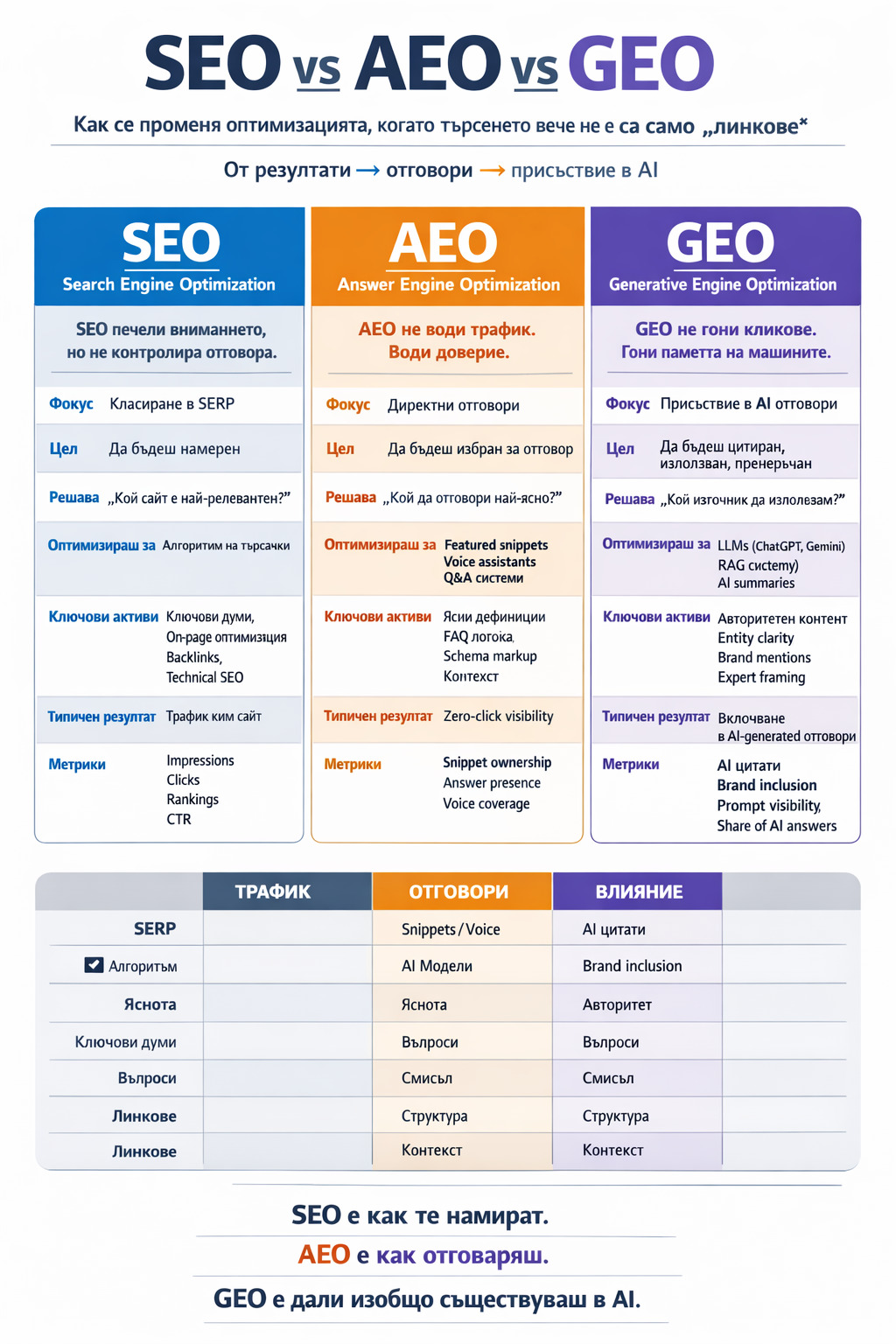
Comparative Analysis: SEO vs AEO vs GEO
| Aspect | SEO | AEO | GEO |
|---|---|---|---|
| Primary Objective | Drive organic traffic to website | Provide direct answers without clicks | Drive local customers to physical locations |
| Key Platforms | Google organic results, Bing | Featured snippets, voice search, knowledge panels | Local Pack, Maps, “near me” searches |
| Content Focus | Comprehensive, in-depth content | Concise, direct answers | Localized, community-focused content |
| Measurement KPIs | Rankings, traffic, conversions | Featured snippet acquisition, answer accuracy | Local pack ranking, direction requests, calls |
| Technical Requirements | Site architecture, speed, mobile optimization | Schema markup, Q&A formatting | GBP optimization, local schema, NAP consistency |
| Time to Results | 3-6 months for significant traction | 1-3 months for answer positioning | 1-2 months for local pack visibility |
| Competitive Intensity | High across most industries | Medium, but growing rapidly | High in competitive local markets |
| Integration Ease | Foundation for other approaches | Can be layered onto SEO content | Requires separate local presence optimization |
Different Target Objectives and KPIs
SEO Success Looks Like:
- Page 1 rankings for target keywords
- Consistent organic traffic growth
- High-quality backlink profile development
- Increasing domain authority metrics
- Conversions from organic channels
AEO Success Looks Like:
- Featured snippet acquisition for target questions
- Inclusion in “People Also Ask” boxes
- Voice search answer provision
- Knowledge panel inclusion for entities
- Zero-click engagement metrics
GEO Success Looks Like:
- Local Pack (Map Pack) inclusion
- High local search visibility
- Consistent review generation and management
- Direction requests to physical locations
- Phone calls and visits from local searches
Overlap Areas and Synergies
Despite their differences, SEO, AEO, and GEO share significant overlap:
Content Optimization Synergies:
- Well-structured SEO content can be easily adapted for AEO
- Local content (GEO) benefits from both SEO and AEO optimization
- FAQ pages serve both AEO (featured snippets) and SEO (long-tail traffic)
- Local business information benefits from AEO optimization in knowledge panels
Technical Infrastructure Overlaps:
- Mobile optimization critical for all three
- Page speed impacts SEO rankings, AEO eligibility, and GEO conversions
- Schema markup supports SEO understanding, AEO extraction, and GEO local business display
- Secure HTTPS required for all approaches
Authority Building Convergence:
- Backlinks improve domain authority (SEO), answer credibility (AEO), and local prominence (GEO)
- Positive reviews impact local rankings (GEO) and can be featured in rich snippets (AEO/SEO)
- Social signals contribute to all three methodologies
- Brand building supports authority across all search verticals
When to Prioritize Each Approach
Prioritize SEO When:
- You’re building a new website or digital presence
- Your business operates primarily online (e-commerce, SaaS, digital services)
- You have resources for long-term content development
- Your target market is regional, national, or global rather than hyper-local
- You’re establishing thought leadership in your industry
Prioritize AEO When:
- Your industry has many common questions or “how-to” queries
- You’re in a competitive market where zero-position gives significant advantage
- Voice search is particularly relevant to your audience
- You want to establish immediate authority on specific topics
- You have content that can be easily structured for direct answers
Prioritize GEO When:
- You have a physical location customers visit
- You serve specific geographic areas
- “Near me” searches are common in your industry
- Your competitors are actively optimizing for local search
- You want to drive foot traffic, phone calls, or local inquiries
Most businesses need some combination of all three, with emphasis shifting based on business model, industry, and target audience.
Integrated Strategy: The Holistic Approach
Creating Content That Serves All Three
The most effective digital visibility strategy integrates SEO, AEO, and GEO within a unified content framework. Here’s how to create content that serves all three methodologies:
The Integrated Content Creation Process:
- Keyword/Question/Location Research:
- Identify primary SEO keywords with commercial intent
- Extract related questions for AEO optimization
- Determine local variations and “near me” opportunities
- Analyze competitor approaches across all three areas
- Unified Content Structure:
- Begin with direct answer to primary question (AEO optimization)
- Expand into comprehensive coverage (SEO optimization)
- Include local context, examples, and case studies (GEO optimization)
- Structure with clear headers for both human readability and machine parsing
- Multi-Format Content Development:
- Text content optimized for featured snippets
- Video answers for YouTube and video results
- Local imagery with geo-tagging
- Structured data implementation for all relevant schema types
- Distribution and Amplification:
- Share on local business listings (GEO)
- Optimize for social sharing and backlink acquisition (SEO)
- Submit to Q&A platforms and knowledge bases (AEO)
- Promote to local communities and organizations (GEO)
Example: A dental practice creating content about “dental implants”:
- SEO: Comprehensive guide covering types, procedures, costs, recovery
- AEO: Direct answers to “How much do dental implants cost?” “Are dental implants painful?”
- GEO: Localized content about “dental implants in [City],” featuring local case studies, mentioning local landmarks, optimizing for “dental implants near me”
Technical Infrastructure Supporting Integration
Your website’s technical foundation must support all three methodologies:
1. Mobile-First Architecture:
- Responsive design that works on all devices
- Accelerated Mobile Pages (AMP) implementation for faster loading
- Mobile-optimized navigation and user interface
- Location detection for personalized local content
2. Structured Data Implementation:
- LocalBusiness schema with complete NAP information
- FAQ schema for question/answer content
- How-to schema for instructional content
- Review schema for testimonials and ratings
- Event schema for local events and workshops
3. Performance Optimization:
- Core Web Vitals compliance (LCP, FID, CLS)
- Image optimization and lazy loading
- Minimized CSS and JavaScript
- Content Delivery Network (CDN) implementation
- Caching strategy for faster load times
4. Localized Technical Elements:
- Location-specific pages with unique content
- Hreflang tags for multi-language local targeting
- Local server hosting when targeting specific regions
- Google Business Profile API integration
- Local review aggregation and display systems
Workflow and Team Structure Recommendations
Integrating SEO, AEO, and GEO requires coordinated effort across roles:
Recommended Team Structure:
- SEO Specialist: Oversees overall strategy and technical implementation
- Content Strategist: Develops integrated content across methodologies
- Local Marketing Manager: Manages GEO elements and local presence
- Technical Developer: Implements structured data and performance optimization
- Analytics Specialist: Tracks performance across all channels
Unified Workflow Process:
- Monthly Planning Session:
- Review performance metrics across SEO, AEO, GEO
- Identify opportunities based on search trends
- Prioritize initiatives with highest integrated impact
- Allocate resources across methodologies
- Weekly Content Development:
- Create content addressing SEO keywords, AEO questions, and GEO opportunities
- Optimize existing content for additional methodologies
- Update local listings and Google Business Profile
- Develop location-specific content variations
- Daily Monitoring and Engagement:
- Respond to reviews and local questions
- Monitor featured snippet performance
- Track local ranking fluctuations
- Engage with local social media communities
- Quarterly Strategy Review:
- Analyze comprehensive performance data
- Adjust strategy based on algorithm updates
- Expand into new question types or local markets
- Reallocate resources based on ROI analysis
[CASE STUDY]
A regional chain of fitness studios implemented an integrated SEO/AEO/GEO strategy across their 12 locations. Within 9 months, they achieved:
- 45% increase in organic website traffic (SEO)
- Featured snippets for 23 common fitness questions (AEO)
- Map Pack inclusion for all 12 locations (GEO)
- 180% increase in free trial signups from local search
- 65% increase in membership renewals attributed to local community content
Their integrated approach included:
- Location-specific pages with unique content about neighborhood fitness culture
- FAQ content addressing common workout questions, optimized for featured snippets
- Local events promoted through Google Business Profile and local community sites
- Schema markup for fitness classes, trainers, and schedules
- Local backlink campaign through community partnerships
Case Study: Successful Integrated Implementation
Background:
A home services company offering plumbing, electrical, and HVAC services across three metropolitan areas struggled with digital visibility. They had inconsistent SEO efforts, no AEO strategy, and incomplete GEO optimization.
Challenges:
- Low organic visibility despite high commercial intent searches
- Competitors dominated featured snippets for common home repair questions
- Inconsistent local presence with outdated business information across directories
Integrated Strategy Implementation:
Phase 1: Foundation Building (Months 1-3)
- Complete technical SEO audit and fixes
- Google Business Profile optimization for all service areas
- Basic schema markup implementation
- Consolidated service area pages with unique local content
Phase 2: Content Development (Months 4-6)
- Created 50 comprehensive service guides (SEO)
- Developed 200 question/answer pages for common home repair issues (AEO)
- Produced location-specific content for each service area (GEO)
- Implemented FAQ, How-to, and LocalBusiness schema throughout
Phase 3: Authority Building (Months 7-9)
- Review generation system implementation
- Local citation cleanup and expansion
- Guest content on local home improvement blogs
- Community sponsorship with digital recognition
Phase 4: Optimization and Expansion (Months 10-12)
- Voice search optimization for emergency service queries
- Local service page expansion with neighborhood-specific content
- Video answer development for common repair questions
- Competitor gap analysis and strategic targeting
Results After 12 Months:
- Organic traffic increased by 320%
- Featured snippets acquired for 67 emergency service questions
- Local Pack inclusion in all target neighborhoods
- Phone calls from local search increased by 240%
- Cost per acquisition decreased by 65% compared to paid advertising
- Estimated annual revenue increase of $850,000 attributed to integrated search strategy
Key Learnings:
- Integration requires upfront investment but delivers compounding returns
- Each methodology strengthens the others when properly aligned
- Local content performs double duty for GEO and establishes authority for AEO
- Technical infrastructure supporting all three methodologies is non-negotiable
- Measurement must track cross-methodology impact, not just individual metrics
Conclusion
The evolution from traditional SEO to the trifecta of SEO, AEO, and GEO reflects the broader transformation of search from a simple information retrieval system to a complex ecosystem serving diverse user needs across multiple contexts. The businesses that will thrive in the coming years aren’t those that excel at just one methodology, but those that master the integration of all three.
Key Takeaways:
- SEO remains the foundation of digital visibility, but it’s no longer sufficient alone. The comprehensive approach to content and technical optimization provides the base upon which AEO and GEO strategies are built.
- AEO represents the present and future of question answering. As voice search grows and users expect immediate answers, optimizing for direct answer placement becomes increasingly critical for brand visibility and authority.
- GEO delivers hyper-local advantage that national competitors can’t easily replicate. For businesses with physical locations or local service areas, GEO optimization provides a defensible competitive moat.
- Integration creates synergy where the whole becomes greater than the sum of its parts. Content serving multiple methodologies delivers compounding returns on investment.
- Measurement must be holistic, tracking not just individual methodology success but cross-channel impact and overall business outcomes.
Future Trends: AI, Personalization, and Semantic Search
Looking ahead, several trends will further shape the integration of SEO, AEO, and GEO:
AI-Powered Search Evolution:
Google’s Search Generative Experience (SGE) and other AI interfaces will further blur the lines between traditional search and direct answers. Optimization will need to consider:
- AI training data sources and content preferences
- Conversational query patterns and follow-up questions
- Multi-format content presentation (text, images, video, interactive elements)
- Authority signals that AI systems recognize and value
Hyper-Personalization:
Search results will become increasingly tailored to individual users based on:
- Search history and behavior patterns
- Location history and frequented places
- Device usage patterns and preferences
- Demographic and psychographic profiling
Semantic Search Maturation:
Google’s understanding of context, nuance, and entity relationships will continue to improve, requiring:
- Even greater focus on topic clusters rather than isolated keywords
- Entity optimization alongside keyword optimization
- Contextual understanding in content creation
- Relationship mapping between concepts, products, and services
Local Search Innovation:
Augmented reality interfaces, real-time availability integration, and hyper-local content will transform GEO, requiring:
- AR-ready business information and visual assets
- Live inventory and appointment integration
- Micro-community content development
- Real-time local event and opportunity optimization
Final Actionable Recommendation
Begin your integrated strategy today with these immediate steps:
- Conduct a tri-methodology audit of your current digital presence
- Prioritize based on your business model—more GEO if local, more AEO if question-heavy industry, solid SEO foundation always
- Develop one piece of integrated content this week addressing all three methodologies
- Optimize your Google Business Profile completely if you have any local component
- Implement basic schema markup for your core content types
- Establish measurement baselines for all three methodologies
- Create a quarterly integration plan with specific cross-methodology initiatives
The fragmentation of search into specialized methodologies isn’t a complication—it’s an opportunity. By mastering and integrating SEO, AEO, and GEO, you create a comprehensive digital visibility system that reaches users wherever they search, however they search, and whatever they’re searching for.
Your Call to Action: Don’t choose between SEO, AEO, and GEO. Choose all three. Start with one integrated project this month, measure the impact, and scale what works. The future of search belongs to those who understand that different search contexts require different optimization approaches—and who build systems that address them all simultaneously.
The journey to integrated search excellence begins with a single step. Take that step today by auditing one aspect of your current strategy through the lens of all three methodologies. Identify the gaps, recognize the synergies, and build your first truly integrated content piece. Your future digital visibility depends not on choosing the right methodology, but on integrating all the right methodologies.